
Nuclear Energy - Dying Technology or Climate Savior?
Published:
Last updated:
Climate change, specifically rapid climate change due to anthropogenic carbon emissions (referred to as climate change in this article) has become a hot topic for several years now. Many companies have recognized climate change as a threat to our ecosystems and are trying to reduce their own carbon emissions in the next decade. I recently attended a seminar in one of my classes, the Technology and Management Seminar offered by the University of Illinois Urbana-Champaign, where guest speakers discussed the importance of being attentive to climate change and what their company is doing to reduce carbon emissions.
Curious about this problem that has been passed down from older generations that is now my generations’ problem to solve, I did some research on where our carbon emissions came from and what solutions our generation must make (in fact I wrote my final research paper on it in my final composition class). I broke down where most of US energy consumption comes from, but more recently I’ve looked into cleaner forms of energy generation. I’ve always heard about the promotion of wind and solar, but they generate only a small fraction of the energy necessary to power America.
And then I stumbled upon nuclear energy.
First, let me be clear what I mean by nuclear energy. There are two forms of energy generation that have nuclear in them: nuclear fission and nuclear fusion. While these two forms of energy have very similar names, they are very different. To keep things simple, nuclear fission uses a radioactive element, typically uranium, to excite nearby atoms that in return create heat. In a nuclear power plant, engineers have figured out different ways to convert heat energy to electricity. It accounts for 18.9% of energy production in the United States (U.S. Energy Information Administration, eia.gov) and is carbon emission free. Nuclear fusion energy is an emerging technology that uses the same reaction that occurs in the sun to create energy by slamming atoms together to form bigger atoms. It does not produce long lived nuclear waste like nuclear fission does and is not currently used in the US for commercial energy production.
Being both curious about technology and an avid problem solver, I read every article from credible organizations on nuclear. I quickly found government bodies and associations preaching the benefits of nuclear:
“Nuclear power is the only large-scale energy-producing technology that takes full responsibility for all its waste and fully costs this into the product” - world-nuclear.org
Radioactive Waste Management - World Nuclear Association. Retrieved from ‘https://www.world-nuclear.org/information-library/nuclear-fuel-cycle/nuclear-wastes/radioactive-waste-management.aspx’
Nuclear not only takes full responsibility of its waste, it also nets zero carbon emissions. The most common reactor designs use water to convert to steam to spin a turbine, which then cools down again. Even in these designs, not even gaseous water is emitted, though backup generators may use fossil fuels for safety purposes.
Nuclear has tons of benefits. Compared to other forms of electricity generation, Nuclear reactors are the most reliable (The Ultimate Fast Facts Guide to Nuclear Energy, energy.gov), carbon emission free, and power dense. In comparison, fossil fuels actively destroy habitats and ecosystems by contaminating environments with heavy metals like mercury, which does not break down and decay (but nuclear waste does). By creating so much energy in a small amount of space, Nuclear takes the least amount of habitat space, whereas fossil fuel sources take more area to create the same amount of energy.

Hannah Ritchie (2022) - “How does the land use of different electricity sources compare?”. Published online at OurWorldInData.org. Retrieved from: https://ourworldindata.org/land-use-per-energy-source [Online Resource]
Nuclear waste is one of the major concerns against using nuclear power, but it isn’t as bad as you’d think.
“… The total amount [of nuclear waste] produced by the US nuclear industry over the last 40 years would, if stacked side by side, cover a football field to a height of about seven metres” - world-nuclear.org
The Nuclear Debate. Retrieved from ‘https://world-nuclear.org/information-library/current-and-future-generation/the-nuclear-debate.aspx’
This may seem like a lot of waste, but that’s all of US history. In comparison to CO2 emissions, there were 5.13 billion metric tons of CO2 emitted in 2019 (U.S. Energy Information Administration, eia.gov). If you did the same volume comparison of CO2 emissions to nuclear waste, that’s 553 million meters of football field. To put this into perspective, the nuclear waste in all of US history on a football field would be roughly the height of a two-story house, and the volume of CO2 emissions at standard temperature and pressure in just one year would be that same football field going to the sun… times 5.8. I tried visualizing the two volumes in CAD for this article but could not see the nuclear waste one:
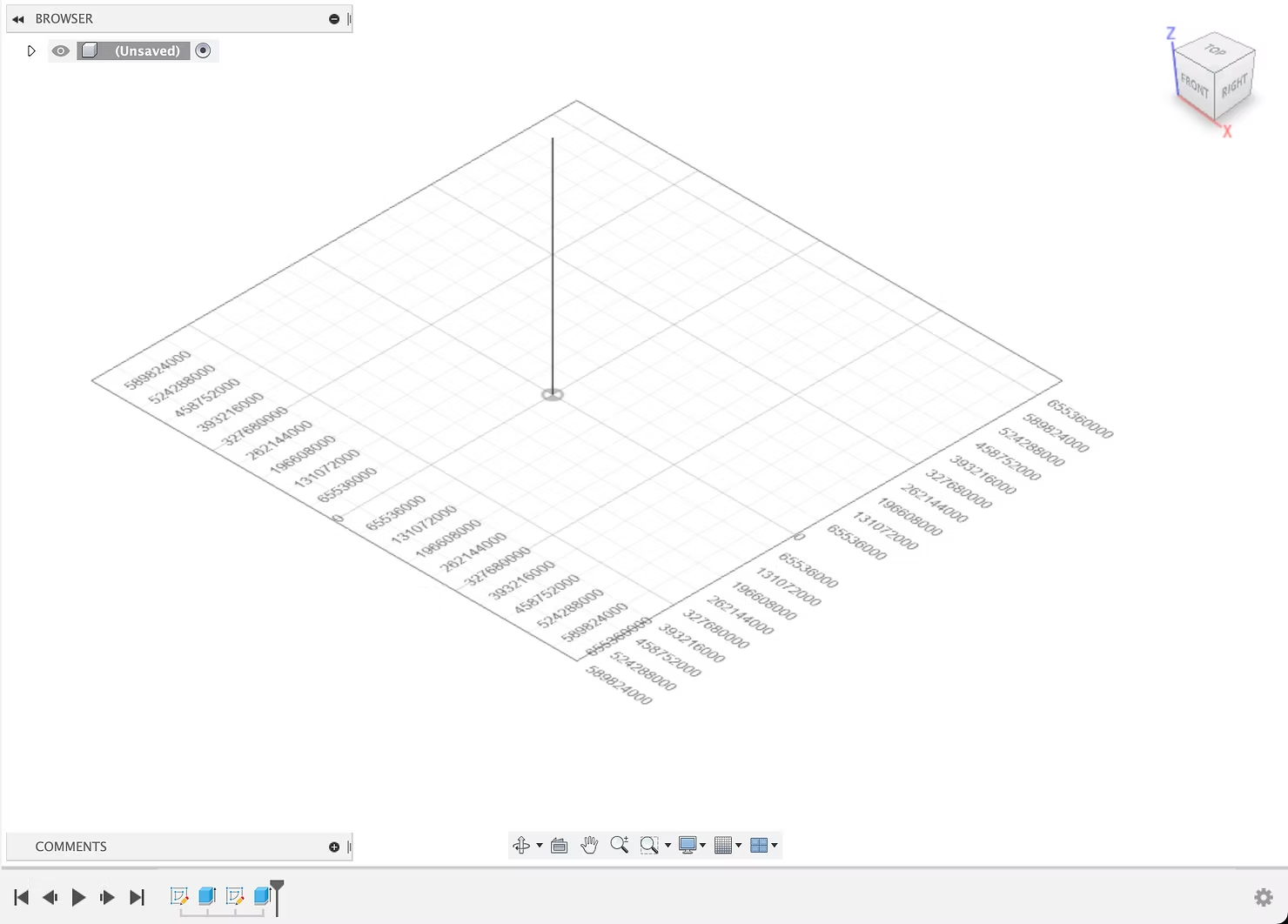
The two volumes represented as the dimensions of a football field in Fusion 360. I had to zoom in for a few minutes before I could see the other shape.
Overall, nuclear is a very climate friendly solution. The best argument against nuclear is actually the economics. Companies would use nuclear if it was cheaper to operate than natural gas, but it’s not. Hopefully in the next few decades’ technology progresses and nuclear becomes cheaper, but for now I will continue trying to teach the benefits and debunk the myths of nuclear power.
Author’s addendum: There seems to be varying information on whether Nuclear Power faces economic challenges for development. The economics of electricity generation vary greatly based on country, subsidies, access to natural resources, macroeconomic trends like: wars, tariffs, and trade agreements and much, much more. Please take generalized economic statements lightly and use your best judgment as an individual to discern nuances.
